

By Ted Harbin
When T. Joe Cahill coined the moniker “The Daddy of ’em All” for Cheyenne Frontier Days, it fit. Created in 1897, the Wyoming celebration grew into the largest outdoor rodeo and Western celebration.
By 2026, the debate about Cheyenne rages on social media. It’s an argument that began in 2019, when organizers switched to the tournament-style format. Entries are limited, which benefits the locals but not the contestants’ opportunities. Rodeo rigs are considerably bigger than they were 20 years ago, so cutting down on entries means managing the space available a little better.
The format, proponents say, is better for general rodeo fans to understand – while die-hards get the longstanding aggregate configuration that still dominates rodeo today, most one-day audience members want to know who won that day.
Opponents point to the decrease in overall payout. Rodeo features local dollars (“added money”) that are mixed with contestants’ entry fees to make up the purse in each event. Cutting out entry fees from most who would enter Cheyenne means fewer dollars in the kitty. It’s an interesting phenomenon, considering Cheyenne features nearly $1 million in added money, up from $770,000 in 2025 to $960,000; that’s $100,000 per event except steer roping, which is tapped out at $60,000.
In comparison, let’s look at the 2018 potential (before it was a tournament) compared to today using saddle bronc riding: Cowboys competed in two go-rounds, with each paying the winners $4,889. The short-round winner earned $1,650, as is the norm in championship rounds even today. The average champion, Brody Cress, earned $7,334. Had one person won all three rounds and the aggregate, earnings would have been $18,762.
Had a bronc rider won every round possible in 2025 – just as Brody Cress did in winning his hometown rodeo for the fourth time – the earnings totaled $15,216. That’s more than $3,500 difference, and that’s why contestants are sparking the debate. In his first year winning Cheyenne in 2017, Cress pocketed $14,241 and won just one go-round, the short round, which pays the least. Potential earnings for bronc busters that year were $18,818.
While many rodeos are trending upward – upcoming stops in Dodge City, Kansas; Spanish Fork, Utah; Castle Rock, Colorado; Lovington, New Mexico; Hermiston, Oregon; and Gooding, Idaho, have continued to increase added money – the payout at one of the longest-running rodeos has decreased.
That’s what has sparked the argument. Debate is good for society. It’s good for each side to consider the other opinion. The Cheyenne committee has to make the decision that is best for its rodeo. In doing so, organizers knew there would be some friction. Some continue to be rubbed the wrong way, and that’s OK. It’s like watching TV; if the program isn’t to their liking, they can change the channel. If Cheyenne isn’t your cup of tea anymore, then don’t enter.
There are plenty of opportunities out there to make a good living, and that’s the most important aspect of rodeo.
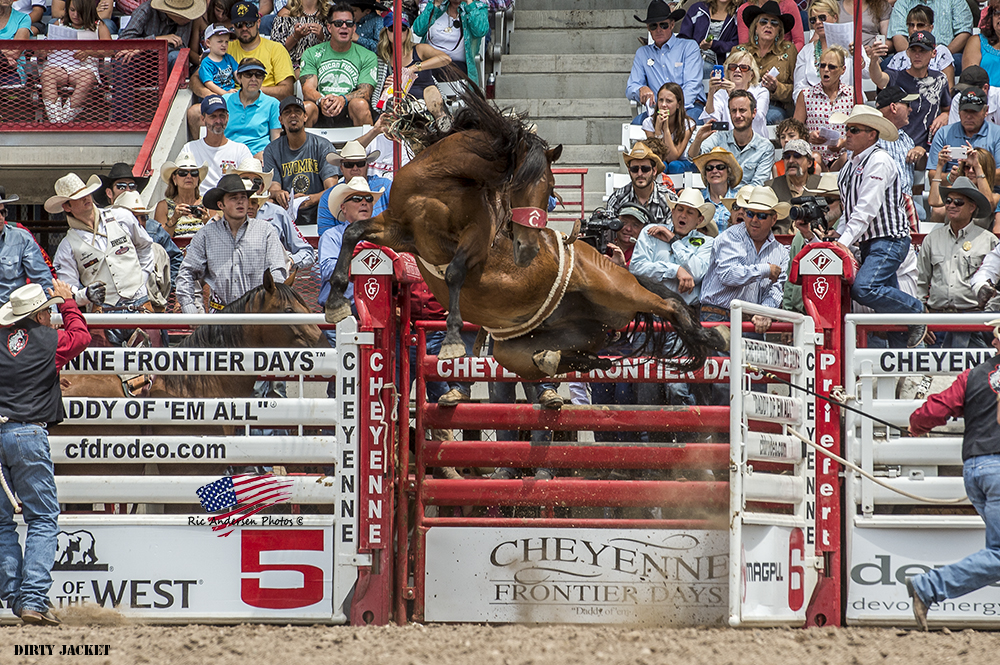
The photo above, taken by Ric Anderson and courtesy of Pete Carr Pro Rodeo, shows Richmond Champion winning Cheyenne Frontier Days in 2014 aboard Carr’s Dirty Jacket.

No comments yet. You should be kind and add one!
By submitting a comment you grant Rodeo Life a perpetual license to reproduce your words and name/web site in attribution. Inappropriate and irrelevant comments will be removed at an admin’s discretion. Your email is used for verification purposes only, it will never be shared.