
By Ted Harbin//Feature Photo Courtesy of Ted Harbin
Ideally, the vests serve as a sort of camouflage.
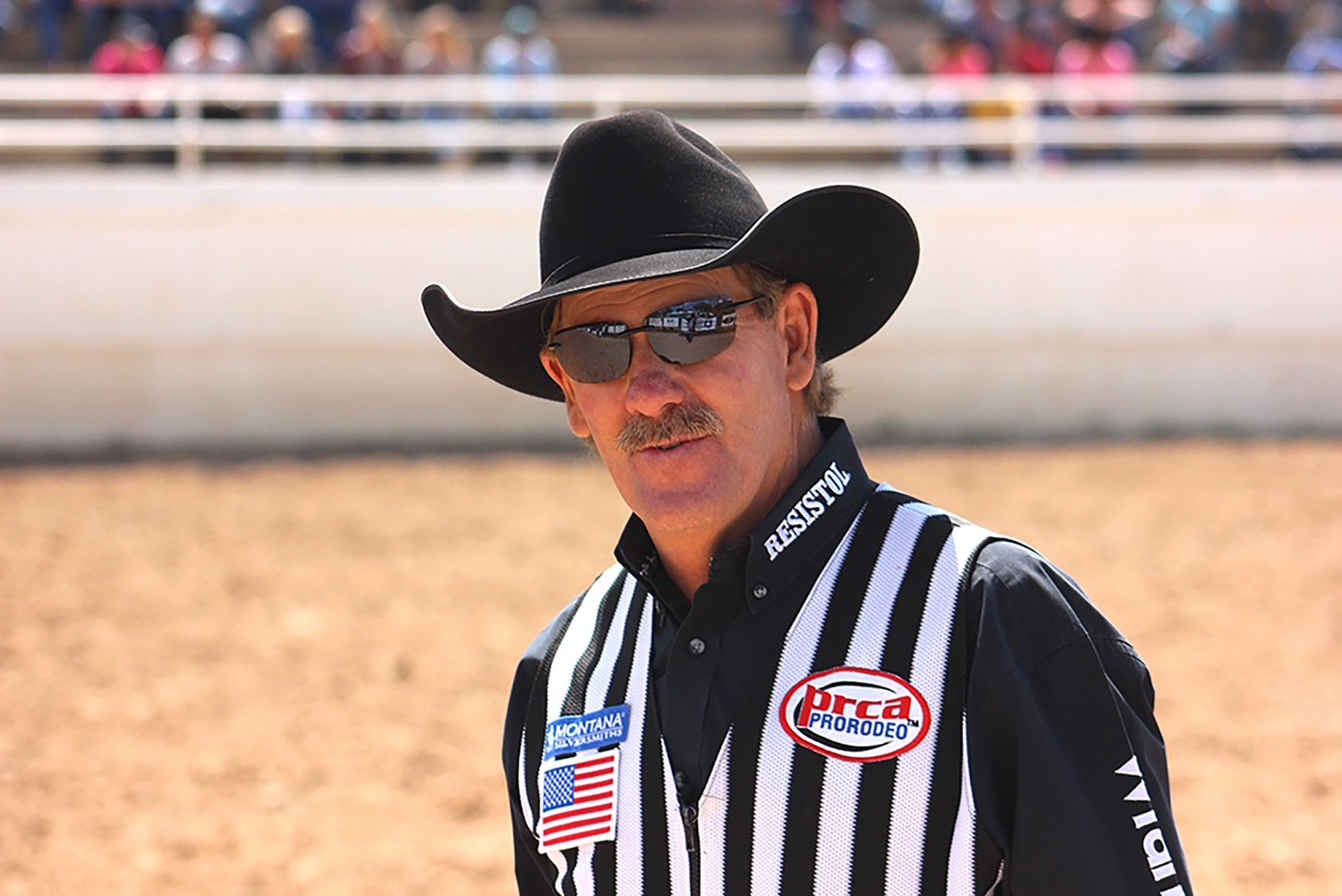
The men who wear them don’t want to be seen, but their jobs involve not only wearing the black-and-white stripes but making judgment calls necessary to sport. It’s a thankless task but necessary. They are the rules-keepers, referees, umpires, ProRodeo officials.
The PRCA employs 167 judges, eight of whom are full-time. The others are considered part time because they might have other jobs they can handle when the rodeo season isn’t quite so hectic. In the three months of July, August and September, there seems to be plenty of rodeo work to keep most occupied.
Just like they did when they competed, these cowboys crisscross the country tending to their business. It may be spending the one day off in two weeks traveling 17 hours from one stop to another, just in time to make it to the next competition. It’s a passion and an understanding that not everyone is going to agree with their decisions.
“What comes to mind for me is two reasons why people decide to be judges,” said Ron Howard, a 43-year veteran and now the PRCA’s supervisor of ProRodeo officials. “You do it because you want to ensure the rules are followed, that procedure is done correctly and potentially the right guys get the money.
“The second reason, and maybe the most important, is the love of the game. As we aged, there are a whole bunch of us that can no longer ride or ride to the extent that the younger guys can. You still wanted to be involved and you loved rodeo, and judging was a way for you to still be part of it. I think, to this day, it’s not for the money. It’s for the love of the game.”
That affair, for most, began decades ago. They rode the rank ones or flanked the big ones. Some made the National Finals Rodeo. Most didn’t. Their affection for the game never waned.
Howard became an educator, which offered him extended summers to officiate rodeo. As he matured in his primary profession, he became an administrator.
“I judged rodeos since 1983, and I quit when I took this job, which was in January 2025,” he said. “I judged probably every big rodeo that you could think of. I was always in school in education, originally as a school teacher, and then as a superintendent. That kind of limited – especially once I got to be a superintendent – the amount of time I could spend judging.”
As a teen, Howard rode bareback horses and bulls, then focused on bovines during a professional career from 1978-’88.
“The last few years, I not only entered, but I also judged at that time, as did a lot of people,” Howard said. “Back then, I think maybe the pay was about $100, if I remember right. You may not have gotten anything for slack, and you may or may not have gotten anything for a per diem.”
That’s much different today. Judges are paid $1 per run during slack, then receive per-performance pay. Per diems also come into play to account for expenses incurred. If slack begins a day before the first show, then judges will receive additional money to cover some of the costs associated with it. There is also an adjustment to compensate for the rodeo itself.
“Based on the size of the rodeo is how much you get paid,” he said. “It used to be based on your ranking, but now it’s based on the size of the rodeo. If you’re not a high-enough-ranked judge, you can’t even put in for that size of rodeo as a reserve official.
“We also said right at the beginning that we try to reward those guys where they can maybe subsidize other employment that they have and make a nice summer wage. We also changed it pretty substantially: It used to be the more performances that you work, the less you got paid, which I never quite did understand. Now, at Houston with 20 performances, for instance, you get paid the same amount of money for the first performance as you do for the last performance as opposed to trickling down over time where you were getting paid less.”
The men still did it. Working an event like RodeoHouston offers prestige, and there’s something to be said for that. It still paid well. Now, though, the judges are compensated better. Theirs is a job that is often criticized. Armchair quarterbacks will disagree with the officials’ decisions and will blast the calls on social media.
Opinions will differ. Debate can be good. Men under Howard’s watch make judgments based on their interpretation of the rules. They not only keep PRCA and WPRA rulebooks with them, but they go through extra training.
“Everybody has to go to a clinic every other year, but now we also test them,” he said. “We send out weekly information about calls that are being made. We study video and critique performance. We talk about positioning and attention to detail. The upper-level guys have Teams (video) calls. We also incorporate directors, like with the WPRA, to ensure that we’re having a well-rounded discussion about specifics.
“We also have field reps that I work with and send out to work with the guys to observe, mentor, help and, ultimately, evaluate. We’ve updated the educational aspect pretty substantially the last 18 months. We’ve also started a boot-camp seminar for new people, kind of like an umpire school for Major League Baseball. Those guys are required to have two years of experience at another level, and they’re required to pass some testing and come to a four- or five-day seminar, where they are taught and critiqued.”
When those courses close, those judges-in-waiting are either allowed to begin the next step in the process – shadowing and working with field representatives – or they’re “sent back to the minor leagues, if you will,” he said.
“We started with 15 guys last fall, and about eight of them made the grade. This past spring, we had one in Laramie (Wyoming) that was the full-blown, five-day thing. There were 16 at the seminar, and we had nine who got to start the next process. Of that nine, I think seven are actually judging for us right now.”
ProRodeo officials follow certain criteria to know when it’s appropriate to drop the flag on a timed-event run or what scores to give in a roughstock ride. Even then, there might be reasons why one marks the ride 39 points out of 50 and the other jots down 43. Maybe the right foot was spurring better than the left, so the cowboy earned four more points from the official on that side.
What Howard and the PRCA don’t want to see is one judge marking the animal considerably more than the other. Their numbers – 1-25 for each the cowboy and the animal – should be similar when marking the horse or bull.
“We have a criteria,” he said. “We really study that criteria, and that marking should be very consistent on both sides.”
It’s about being in the best position possible to see the entirety of the ride.
“If you can’t move or you’re not willing to move, we’re probably not willing to rank you at the highest level,” Howard said. “We’re moving away from the days of being 70 years old, 60 pounds overweight and can’t get on the horse. That’s a very blunt statement, but it’s a very true statement.
“I could care less how old you are if you’re in good enough shape that you can get where you need to be to be able to do your job, and that requires you being able to move out through the arena.”
As with other sports, there have been controversial calls. Should pass interference be called? Was the shooters foot on the three-point line, or was it behind the arc? Some flaggers might see crossfire in team roping differently. At the 2025 NFR, 10-time world champion Stetson Wright was called for a missed mark-out. In the first finale with instant replay, the controversy became more heated when many saw video of Wright’s feet seemingly in the correct position on the first jump out of the chute.
The instant-replay officials upheld the arena judge’s call instead.
“I think where we made our mistakes last year is that I was not up to par enough on it with regard to having the guys in the booth agree to their calls,” Howard said. “Somehow, we got fixated on, ‘This guy’s going to call this, and this guy is going to call this.’ I thought we were working together to come up with our calls. That didn’t happen, but it will this year.
“For instance, if Ron Howard misses his horse out and a flag is thrown, both officials in the replay booth will work together and come up with an agreement as to whether that was a miss-out or not.”
Every referee, umpire and rodeo judge will miss some calls. They’ll not see a blatant holding call or not call a foul or drop the flag when all four legs of a bulldogging steer are not cleared. They might mark a spur ride too many points, then just have to go higher when they see a better one. The key for Howard is learning from those errors.
“We’re always charging and trying to get better,” Howard said. “That’s really important, but so is learning from your mistakes. That’s going to make you better in the long run.”
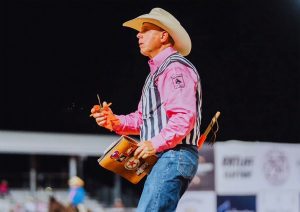
Photo courtesy of the West of the Pecos Rodeo

No comments yet. You should be kind and add one!
By submitting a comment you grant Rodeo Life a perpetual license to reproduce your words and name/web site in attribution. Inappropriate and irrelevant comments will be removed at an admin’s discretion. Your email is used for verification purposes only, it will never be shared.