

By Ted Harbin
Photo Courtesy of Ted Harbin
There’s a different aura surrounding this Fourth of July.
It’s the 250th anniversary of the United States of America gaining its sovereignty from the British, the semiquincentennial of the signing of the Declaration of Independence.
Americans have honored that specific day for centuries, and rightfully so. It’s an opportunity for patriotism to shine. This year, though, means something more. Just as we did 50 years ago for the bicentennial, we want to honor our predecessors and share our love of country.
There will be big celebrations and small. Every town, every city, every community will have parades and events to honor this anniversary, but this is nothing new for rodeo. Whether it’s a regional rodeo in Canadian, Texas, or a major event or the Cody Stampede in Wyoming, the Fourth of July is a time for friends to gather and honor our heritage.
In talking with Oregon bull rider T.J. Gray about his favorite rodeo memory on an ongoing assignment for the PRCA, I learned how much he appreciates his job. Not only does he ride bulls for a living, but he’s a makeshift gypsy, traveling the country to perform his duties. His drives overnight on July 4 remind him of what it means to be an American.
As he heads off to another rodeo, he is blessed with the opportunity to see each community’s fireworks displays along the way. I’ve been on a similar trek, and it’s fascinating to see.
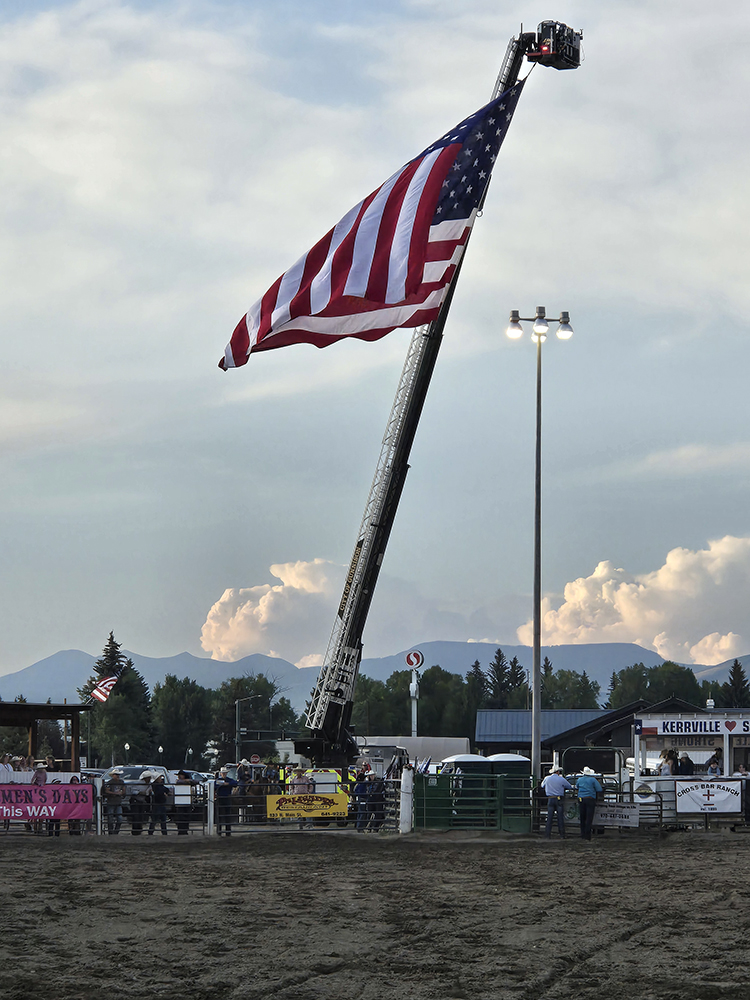
But the same can be said for Guymon, Oklahoma, in May or Hempstead, Texas, in October, because we honor America every performance. In Gunnison, Colorado, the fire department brings its big ladder truck, from which a giant Old Glory waves gracefully. Similar demonstrations take place from sea to shining sea.
The American Revolutionary War began in April 1775, and the Declaration of Independence was signed 15 months later. The battles raged on between the Continentals – also known as Patriots and Minutemen – and the Red Coats until September 1783. Thousands died in their fight for our Independence.
As president of Congress, John Hancock became the first to sign the Declaration of Independence, and he was followed by 55 other delegates from the original 13 colonies. The signatories included men who have held their places in history, like Thomas Jefferson, John Adams and Benjamin Franklin.
“The Star-Spangled Banner” was written by Francis Scott Key in 1814, and “God Bless America” was penned by Irving Berlin four years later. Both are appropriate every day but more so on the Fourth of July.

No comments yet. You should be kind and add one!
By submitting a comment you grant Rodeo Life a perpetual license to reproduce your words and name/web site in attribution. Inappropriate and irrelevant comments will be removed at an admin’s discretion. Your email is used for verification purposes only, it will never be shared.